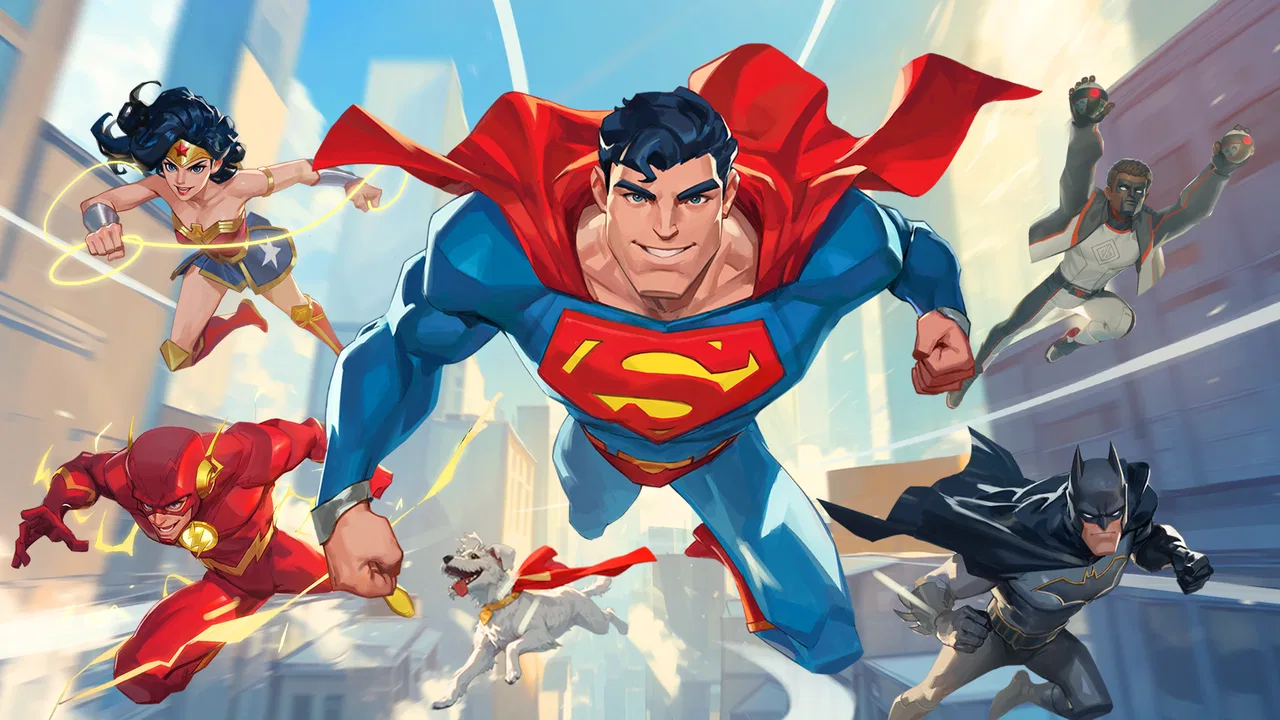
DC Worlds Collide Strategy RPG
- 4.2
- Rating
- 1.00M
- Installs
- Free
- Price

 Analysis by App-foxy
DC Worlds Collide is the kind of role-playing game I open when I want a quick superhero battle with more planning than simple button tapping. I build a team from DC characters, prepare for five-versus-five encounters, and adjust my approach when a fight exposes a weakness. It is free to start, aimed at Teen players, and developed by Warner Bros. International Enterprises.
My first impression is that this is less about controlling every second of a battle and more about making good decisions before and during each encounter. That makes it approachable for someone who enjoys character collection and squad strategy, while still giving experienced mobile RPG players room to think about team balance. It is not a substitute for a deep, traditional console role-playing game, but it can work well in short sessions when I want recognizable heroes and a structured progression loop.
Getting started without unnecessary frustration
The game is available at no purchase price, although individual in-game items range from $0.99 to $199.99. That difference matters. I can begin without paying, but I would still approach the shop carefully and decide in advance whether I am comfortable spending anything. For a younger player, the Teen content rating is also a useful reminder that this is not designed as a small children’s game.
You May Also Like

 Blood Strike: 2.5 Anniversary
Blood Strike’s Loadouts Turn Every Drop Into a Tactical Gamble
A close look at Blood Strike’s custom loadouts: how fast access to signature weapons reshapes its battle royale rhythm, rewards preparation, and narrows the gap between fights.

 Pandora - Music & Podcasts
Pandora’s Music Is Easy to Start, but Harder to Recover
Pandora’s strength is its low-effort path from a seed to a station. Its weak spot is how much confidence it asks you to place in connection, setup, and quiet recovery.

 8 Ball Pool
 Is Built on Rivalries, Rematches, and Routine
A close look at the rivalries, rematches, shared routines, and unanswered safety questions that turn a quick pool match into a persistent mobile community.

 Samsung Music
’s Quiet Strength Is Playing What You Already Own
Its reach comes less from spectacle than from dependable access to a personal library. That simplicity is both the app’s strongest retention engine and its ceiling.

 AccuWeather: Weather Radar
AccuWeather Review: A Quick, Clear Forecast for Everyday Decisions
For everyday plans, the best forecast is the one you can understand quickly. AccuWeather makes rain timing, radar, and local conditions easy to act on, with a few trade-offs.

 Hill Climb Racing
Why Hill Climb Racing Still Turns Crashes Into One More Run
A tiny car, a bumpy hill and one more upgrade: Hill Climb Racing keeps resurfacing because its simple chaos makes every near-miss feel personal.
More From Our News Desk



The listed minimum operating-system requirement is Android 7.1. Before installing, I would check the phone’s software version and leave enough free storage for the download and any additional game files. A device that technically meets the minimum can still feel uncomfortable if it is nearly full, running many background apps, or struggling with heat. Closing unused apps and restarting the phone are simple steps, but they often make a bigger difference than repeatedly tapping the install button.
On iOS or Android, I would also make sure the store account is active and that the connection is stable. If installation pauses, I would switch between Wi-Fi and mobile data only when I know the connection is reliable, then retry from the store rather than repeatedly opening the game. A stalled download is not automatically a problem with the game itself; account verification, storage, or a temporary network interruption can all look similar from the user’s side.
The current version is 1.1.16.3, so I would check that the installed build matches the latest version shown by the relevant app store. If the game opens but behaves strangely after an update, I would first close it completely, restart the device, and try again. I would avoid deleting local data as an early step, especially if I had not confirmed that my progress is connected to a supported account or recovery method.
Where new players are most likely to get stuck
The opening hours can feel busy because several systems compete for attention: collecting characters, improving them, forming a squad, and learning how battles flow. My advice is not to spend every early resource immediately. I would first identify which characters I actually use together, then improve a small working group instead of spreading upgrades across the entire roster.
That approach is useful because a larger collection can create the illusion of progress without producing a reliable team. A character may look appealing on their own, yet perform poorly when the rest of the squad does not support the same plan. I would test a few combinations in easier encounters before committing scarce materials to a broad set of heroes.
Another common sticking point is treating every fight as if the same team should work. When a battle goes badly, I would look at the sequence of events rather than simply raising power. Did the squad lose one member too quickly? Did the team lack a way to recover from pressure? Was the problem damage, survival, or poor timing? Even without changing the whole roster, moving attention to the actual failure point can make the next attempt more informative.
This is where the game differs from a purely automatic collector. The five-versus-five format gives team construction real importance, but it also means that a weak matchup can make progress feel slower than expected. I enjoy that layer, although players who want to use their favorite characters regardless of role may find the optimization side restrictive.
A practical routine for team building
I would use a simple three-pass routine. First, choose a core group that can survive long enough to act. Second, add characters that improve the team’s main plan rather than selecting five unrelated favorites. Third, test the squad in a manageable battle and observe what happens before spending more resources.
The non-obvious benefit of this routine is that it separates a roster problem from a development problem. If the same character repeatedly falls behind while the rest of the squad performs well, that may be a sign to adjust investment. If everyone struggles, the issue may be the encounter, the team’s general balance, or the need to change tactics. This prevents me from wasting upgrades simply because a single attempt went poorly.
I would also keep a backup formation instead of dismantling the main squad every time I want to experiment. A secondary team gives me a safe place to test different combinations and makes recovery less annoying after an unsuccessful trial. That is especially helpful during a short play session, when I want to learn something without turning the whole account into a rebuilding project.
Recovering when the game or a battle goes wrong
If a battle fails, I would not immediately assume that I need to pay for progress. I would replay the encounter with one deliberate change: a different lineup, a different order of investment, or a more cautious approach to the fight. Changing several things at once makes it impossible to know what helped.
If the application freezes, closes, or remains stuck on a loading screen, my recovery order would be straightforward. I would check the connection, close and reopen the game, restart the device, and confirm that the app is updated. I would also check available storage and avoid switching rapidly between networks while the game is loading. These are general steps, but they target the most common sources of mobile-app friction without risking progress through aggressive troubleshooting.
Clearing temporary cache data can sometimes help on Android, but I would treat clearing full app data or reinstalling as a later option. Before doing that, I would make sure I understand how my progress is preserved. A reinstall may solve a damaged local installation, but it is not a safe first response if I cannot confidently recover the account afterward.
For purchases, I would verify the store account, payment method, and transaction history before trying again. Repeatedly pressing a purchase button during a delay can create confusion about whether the transaction completed. I would wait, check the account, and use the platform’s normal purchase-support process if necessary rather than making several attempts.
When the app is not the real cause
Some problems that feel like game defects are actually device or network limitations. A phone can meet the minimum software requirement and still struggle when its battery is low, its temperature is high, or many demanding apps remain open. If performance changes after the device cools down or after a restart, the hardware environment is probably contributing to the issue.
Connection quality can also be misleading. A strong signal does not always mean a stable connection, and a stable connection does not guarantee that the store account or service endpoint is responding normally. If the game works on one network but not another, I would investigate the network before changing the installation.
Storage is another overlooked cause. Mobile games may need more room during installation or updating than the final application size suggests. I would keep a reasonable buffer free and remove unused downloads before blaming the game. This is particularly important when an update appears to start, stops, and then returns to the same prompt.
Finally, I would distinguish between a design choice and a technical failure. A battle that requires a stronger or better-organized squad is not necessarily broken. Likewise, a progression system that encourages repeated improvement may feel slow to a player who prefers immediate access to every character. Understanding that difference helps me decide whether to troubleshoot, change my strategy, or simply accept that the game’s pace is not a good fit.
How it compares with other mobile role-playing games
Compared with simpler superhero action games, this one asks me to think more about the group than about direct movement or reflexes. That makes it a better choice for players who enjoy arranging a squad and watching a plan develop. Compared with large, story-heavy role-playing games, it is easier to approach in short bursts, but it does not offer the same kind of exploration or fully controlled adventure experience.
It also sits between a character collector and a tactical team builder. The DC setting provides an immediate reason to care about the roster, while the five-versus-five structure gives each selection practical consequences. The trade-off is that collecting alone is not enough. If I only want to unlock familiar heroes and use them without considering compatibility, a less strategy-focused alternative may feel more relaxing.
The free entry point is useful for trying the core loop, but the wide range of optional item prices means I would not recommend treating the shop as a shortcut through every obstacle. I prefer to play first, learn which systems matter to me, and set a spending limit before making any purchase. That keeps the decision under my control instead of letting a difficult encounter dictate it.
Who will enjoy it most
I think it is a good match for a DC fan who likes mobile progression, squad experimentation, and battles that reward preparation. It is also suitable for someone who wants a role-playing game that can be checked in short sessions rather than requiring a long uninterrupted evening. The recognizable universe makes the early learning process more inviting than it might be in an entirely unfamiliar setting.
I would be more cautious recommending it to someone who dislikes repeated character development, collection systems, or the possibility of spending on optional items. Players looking for a fully manual action game may also find the emphasis on squad decisions less satisfying. Likewise, anyone who wants a traditional single-player campaign with a fixed cast should consider a different kind of role-playing game.
For a realistic everyday use case, I can imagine playing during a short break: check the current squad, run a few battles, note which weakness caused a loss, and stop before making rushed upgrade or purchase decisions. That rhythm suits the game better than trying to force a long session while the phone is hot or the connection is unstable.
My final assessment
With an average rating of 4.2 from around 31 thousand ratings and over 1 million installs, the game has found a substantial audience, and I can see why. Its strongest quality is the way the DC theme gives personality to a structured five-versus-five role-playing format. I enjoy having a reason to reconsider a lineup instead of simply repeating the same attack pattern.
Its main friction comes from the same systems that give it depth: progress can feel less direct, team choices matter, and the free-to-start model requires sensible boundaries around purchases. Setup and loading problems should be approached methodically, with storage, updates, accounts, and network stability checked before assuming the game is at fault.
My recommendation is to try it as a thoughtful squad-building RPG, not as a pure action game. Start with a small, dependable team, change one variable when a battle fails, keep a backup formation for experiments, and avoid spending until the progression loop makes sense to you. If that style sounds enjoyable, DC Worlds Collide offers a convenient way to spend short sessions with DC heroes. If you want unrestricted character use, deep exploration, or direct moment-to-moment control, another role-playing option will probably suit you better.
FAQs for DC Worlds Collide Strategy RPG
01What is DC Worlds Collide Strategy RPG?
DC Worlds Collide is a mobile strategy RPG based on DC Comics characters. You collect heroes and villains, build a team, and use their abilities in turn-based battles. The game focuses on campaign progression, character upgrades, team composition, and special events. Players can expect familiar characters from the DC universe alongside an original storyline and competitive features.
02Is DC Worlds Collide free to play?
DC Worlds Collide can generally be downloaded and played for free, but it includes optional in-app purchases. These purchases may provide premium currency, upgrade resources, character summons, or progression bundles. You can advance without spending money, although progress may require more time and patience. As with many free-to-play RPGs, spending can make upgrades and recruitment more convenient.
03Does the game require an internet connection?
Yes, DC Worlds Collide is designed as an online game and normally requires an active internet connection. Online access is used to verify your account, save progress, deliver events, manage purchases, and connect you to multiplayer or competitive features. Because of this requirement, the game may not be suitable for uninterrupted offline play during travel or in areas with weak connectivity.
04Which DC characters can I use in DC Worlds Collide?
The roster includes recognizable heroes and villains from the DC universe, although the exact selection can vary according to the game version, region, and current events. Characters are usually obtained through recruitment or other progression systems, then improved with equipment, levels, skills, and upgrades. Team building is important because different characters offer damage, defense, control, or support abilities.
05Is DC Worlds Collide suitable for casual players?
DC Worlds Collide can suit casual players who enjoy collecting characters and making gradual progress, especially because automated battles and daily activities can reduce the time needed for routine play. However, players who want to remain competitive may need to log in regularly for missions, events, and resource collection. The experience is more enjoyable if you are comfortable with long-term progression and optional monetization.
Pros
- Large roster of DC heroes and villains to collect and upgrade.
- Turn-based combat is easy to learn but offers useful team-building depth.
- Frequent events and missions provide plenty of content for regular players.
- Automatic battles and speed controls make routine fights less time-consuming.
- Distinct character roles encourage experimenting with different squad combinations.
Cons
- Progress can feel slow without spending premium currency or waiting for resources.
- Duplicate characters and upgrade materials take up considerable inventory space.
- Energy limits may interrupt longer play sessions.
- Some menus and systems can feel overwhelming for new players.
- Power differences in competitive modes may favor highly invested accounts.

DC Worlds Collide Strategy RPG
Gallery